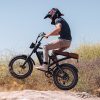
Kingbull Rover 2.0
$1,399
The Rover 2.0 comes with a 750W Bafang motor, a 720Wh Samsung battery, and a frame that can carry 400lbs of load. The setup is supported by Zoom hydraulic brakes, dual suspension, and 26×4” fat tires that give stability on rough ground. With that said, let us now see how the Rover 2.0 performs across performance, range, safety, design, and comfort parameters… and if it’s the right choice for daring rides.
Kingbull Rover 2.0
*To ensure the most accurate evaluation, these tests are done independently with our rider. Please note that our results may differ from the manufacturer’s claims and are intended to provide a transparent and unbiased assessment of each bike’s capabilities.
Highlights
Kingbull Rover 2.0 Review
Summary
Performance
The Rover 2.0 features a Bafang 750W brushless rear hub motor that delivers smooth, silent, and reliable power. Despite being a hub-driven setup, the motor balances consistent torque delivery with predictable acceleration. It churns out approx 85 Nm torque, which gives it serious climbing ability to tackle even steep grades without straining. I found the performance similar to Discover 2.0 that I recently tested.

I also liked the TROG-1B torque sensor. It reads pedal pressure instantly and translates your pedal effort into natural-feeling assistance. There’s none of the “on/off surge” you often see in cadence-based systems. Instead, it feels seamless, almost like an extension of your legs. The torque sensor also helps with hill climbing, and when you’re starting out from rest.
Then, you have the Shimano Altus 7-speed drivetrain, which complements the motor well. It isn’t high-end, but it’s tuned for durability and utility, offering reliable shifts under load. Paired with a 48T crankset and 13-32T freewheel, the gearing range suits both urban cruising and off-road climbs. At speed, it maintains efficiency… and at low gear, it provides enough leverage to climb with assistance.
Range
Power comes from a Samsung 48V 15Ah (720 Wh) lithium-ion battery, securely housed in the integrated downtube compartment. The placement is smart (low and central), which not only preserves the bike’s balance but also protects the pack from vibration and impact. Removal is straightforward for charging or swapping, and the UL-certified 3A fast charger tops it off in about 5 to 6 hours.

On paper, the bike offers up to 60 miles of range, but real-world numbers vary depending on payload and the riding conditions. During my test, the range topped at 34.4 miles (I used PAS 5 almost throughout, and also took the bike to hills). So, expect around 35-40 miles with mixed throttle and pedal assist, or less if riding heavily loaded, on steep terrain, or into headwinds. Those who ride conservatively in lower assist levels can approach the higher estimate. The Jumper Go offers better range due to its larger 960Wh battery.
The torque sensor plays a critical role in battery efficiency. By delivering power proportionally to rider input, it avoids the wastefulness of all-or-nothing cadence systems. This means less unnecessary battery drain, especially in rolling terrain or stop-and-go city riding. You get more miles per charge simply because the system only gives what’s needed.
Safety
Stopping power is handled by ZOOM hydraulic disc brakes with 180 mm rotors front and rear. While not four-piston performance calipers, these two-piston hydraulics provide consistent, predictable modulation and enough bite to rein in an 80lbs bike plus rider. Lever feel is light yet progressive, giving control even on technical descents or in wet conditions. The system integrates a brake cut-off sensor, ensuring motor power disengages instantly when braking.

Lighting is equally well thought out. The bike features an integrated 48V LED headlight with horn and a rear tail light with brake highlight. The headlight draws directly from the main battery and its beam is strong enough for both urban visibility and light trail riding. The rear light brightens when braking, clearly signaling intentions to follow traffic. The bike also has an electric horn to alert road users.

Capability
The Rover 2.0 has a full suspension setup. Up front, the in-house coil fork offers 100 mm of travel, with lockout and preload adjustment to fine-tune response for pavement or trails. Out back, the DNM oil spring shock provides 45 mm of rear travel. It perfectly absorbs chatter, roots, and potholes that would punish a hardtail. Together, the suspension strikes a practical balance of comfort and control… and keeps the bike planted on varied terrain.

Traction comes from CST 26×4.0″ puncture-proof fat tires. Their large contact patch gives confidence on gravel, sand, snow, and loose dirt, while also smoothing rough urban streets. Despite their bulk, rolling resistance is manageable, especially when paired with the torque sensor system, which rewards steady pedaling. The wide profile adds stability under load, making the bike feel secure even at its 28 mph top speed.

Ride Quality
From the saddle up, the bike delivers a balanced and confidence-inspiring ride. The super-plush eco-leather seat with aluminum rails is firm enough for support yet compliant enough for longer trips. The seatpost is height adjustable to comfortably seat riders with 5’6″ to 6’5″ height.

The riding posture is upright and natural, thanks to a 700 mm wide handlebar and a moderate-rise stem. This reduces wrist strain while giving leverage for precise steering. All cockpit elements (shifter, brake levers, twist throttle, and display) are positioned intuitively, so controls feel instinctive and easy to reach.

On the electronics side, the bike offers 5 levels of pedal assist, giving fine control over how much effort the rider contributes. Combined with the torque sensor, assist feels seamless and proportional. Instead of being pulled forward by the motor, you feel like you’re simply stronger and faster.
Design
The Rover 2.0 has a full-aluminum alloy frame that stands out for its stiffness, durability, and corrosion resistance. The geometry blends utility with aggression. The integrated removable battery sits cleanly in the downtube, giving the frame a streamlined profile without the clutter of exposed cabling. Internal routing furthers the clean, professional aesthetic. The bike is available in black and silver.

Up front, the KB35H custom color LCD display is the nerve center. It’s bright, well-organized, and easy to read even in direct sunlight, showing speed, assist level, range, and ride metrics at a glance. Button layout is straightforward, allowing quick adjustments without distraction.

Build quality feels solid throughout. At 80 lbs, it’s not light, but the weight is distributed evenly, keeping the bike stable both rolling and at a standstill. The 400 lb max payload rating confirms the frame’s strength, supporting larger riders and extra cargo without flex or instability. This makes it viable not just as an off-roader, but also for hauling gear. But unfortunately, the bike doesn’t come with a rear rack and fenders, and you need to purchase them separately.
Price
At $1,399, the Rover 2.0 lands in a sweet spot of affordability and performance. Many e-bikes in this price range compromise on components, often skipping full suspension, cutting battery capacity, or relying on cadence sensors. Here, you’re getting a 750W Bafang motor, Samsung 720Wh battery, torque sensor, hydraulic brakes, and full suspension in one package, making it a standout deal in its class.

The offer is sweetened further with a free gift pack that includes a lock, pump, and phone mount. All these are practical accessories that most riders would buy anyway. On top of that, the brand runs a $200 discount when purchasing two bikes.
Kingbull Rover 2.0 Electric Bike
See the Kingbull Rover 2.0*Our content is independent, but buying through our links may earn us a commission.
Conclusion
The Rover 2.0 is built as a true all-terrain machine with a focus on strength and comfort. What impressed me most was how the torque sensor worked with the motor to deliver a natural push every time the pedals moved. It did not feel forced or delayed which made climbs and turns more controlled. The bike held steady over gravel and soft ground while the wide CST tires gave extra grip that felt secure.
Another part I liked is the balance between price and quality. At $1,399, the Rover 2.0 includes parts from trusted brands (Bafang, Samsung, Zoom, Shimano, CST). It also offers full suspension and hydraulic brakes. But unfortunately, it doesn’t include racks and fenders, though you get a gift pack of cable lock, phone mount, and air pump.
Summing it up, the features offered are still rare at this price point. Many models in the same range cut features or limit load capacity, but here you get a strong frame that supports 400 lbs without losing stability besides cutting-edge features. If you want one e-bike that can handle daily commutes and weekend trails, I think the Rover 2.0 is a deal worth taking.
But if you are curious about what else is out there, take a look at these top-rated fat tire e-bikes. For riders who want something lighter on the budget, this list of affordable e-bikes on Amazon is also worth checking out.
Kingbull Rover 2.0 FAQs
Can the Rover 2.0 fit riders of different heights?
Yes, the Rover 2.0 fits riders of different heights. The seat height can be adjusted to accommodate riders from 5’5” to 6’5”.
What is the warranty on the Rover 2.0?
Kingbull gives a 2-year warranty on the frame and main electronic parts. For more details, you can consult Kingbull’s warranty policy on their website.
What is the top speed of the Rover 2.0?
The bike can reach 28 mph in Class 3 mode. You can also switch it to Class 2 for a max of 20 mph speed from display unit settings.
Kingbull Rover 2.0 Specifications
- Motor Type: Bafang (GD) 750W Brushless Rear Hub
- Motor Voltage: 48 V
- Nominal Motor Output: 750 W
- Max Torque Output: ~85 Nm (Bafang est.)
- Max Speed: 28 mph
- Sensor: TROG-1B Torque Sensor + Brake Sensor
- No. of Assist Levels: 5
- Battery: SAMSUNG 48 V 15 Ah (720 Wh) Lithium-ion
- Max Range: 60 Miles
- Charger: 48 V 3 A Smart Fast Charger (UL-Certified)
- Charging Time: ~5–6 Hours
- Brakes: ZOOM HB-875-E Hydraulic Disc Brakes, 2 Pistons, 180 mm Rotors (Front & Rear)
- Suspension (Front): KINGBULL OSD-R26, Coil Spring, 100 mm Travel, Lockable, Preload Adjustable
- Suspension (Rear): DNM DV-22AR Oil Spring, Adjustable Damping, 45 mm Travel
- Frame Material: Full Aluminum Alloy, Full Suspension, Removable Integrated Battery
- Max Load: 400 lbs
- Classes: Class 3 (Default), Class 2
- Transmission: Shimano SL-M315-7R Shifter + Shimano RD-M310 Rear Derailleur (7-speed)
- Display: KB35H Custom Color Display
- Tire Size: CST C-1752 26″ × 4.0″ Puncture-Proof
- Rider Height: 5’6” ~ 6’5”
- Bike Weight: 80 lbs (with Battery)
- Chain: KMC Z7RB, 126L, 7-speed
- Crank Set: HDL-L145, 48T, 170 mm Arms
- Throttle: FT158X Twist Throttle (3-pin, 5V)
- Handlebar: HB703 Aluminum Alloy, 700 mm Width
- Stem: AS507 Aluminum Alloy, EXT: 60 mm, 7° Rise
- Kickstand: Aluminum Alloy Side Kickstand
- Rims: JP73 Aluminum Alloy, 26″ (Front: 13G36H / Rear: 12G36H), H:18 mm
- Saddle: JT5734 Eco-Leather with Aluminum Rails
- Seatpost: SP-601 Aluminum Alloy, 30.4 × 300 mm with Scale
- Spokes: 45# Steel, 13G & 12G with 14 mm Copper Spoke Caps
- Inner Tubes: CST 26″ × 4.0″, Schrader Valve
- Lights: Integrated 48V LED Headlight with Horn + Tail Light with Brake Highlight
- Fenders: Plastic Front and Rear