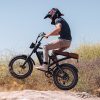
Velowave Grace 2.0
$1,399
At its core, the Grace 2.0 pairs a 750W (1000W peak) BAFANG geared hub motor with a torque sensor, allowing power delivery to scale naturally with rider effort. This is supported by a 960Wh LG battery, one of the larger capacities in its class, aimed squarely at riders who value extended range and consistent power output.
The Grace 2.0 is built for riders who want to cover distance comfortably, whether that means commuting on broken pavement, exploring gravel and dirt roads, or riding year-round in changing conditions. Let’s see what else this bike offers.
Velowave Grace 2.0
*To ensure the most accurate evaluation, these tests are done independently with our rider. Please note that our results may differ from the manufacturer’s claims and are intended to provide a transparent and unbiased assessment of each bike’s capabilities.
Highlights
Velowave Grace 2.0 Review
Summary
Performance
The Velowave Grace 2.0 is built around usable, repeatable power rather than short-lived bursts, and that philosophy is clear the moment you start pedaling. At its core is a BAFANG geared hub motor rated at 750W (1000W peak, 80Nm torque), paired with a torque sensor pedal-assist system. This combination fundamentally changes how the bike accelerates compared to cadence-only fat tire e-bikes. Power doesn’t arrive all at once; it scales with rider input, rewarding effort instead of replacing it.
On pavement, the Grace 2.0 reaches Class 3 speeds of up to 28mph under pedal assist with surprising composure. The motor maintains output well beyond the initial surge, meaning sustained high-speed cruising feels natural rather than forced. This is especially noticeable on long straight sections where many hub-motor bikes flatten out or feel electronically constrained. The 48V system paired with a 25A controller provides enough electrical headroom that the motor rarely feels stressed, even when pushing against wind or mild gradients.

Climbing performance is more nuanced. The 80Nm torque figure doesn’t translate into explosive hill attacks, but instead offers steady, traction-conscious drive. On loose gravel or dirt, the torque sensor prevents sudden wheelspin, allowing the 26” x 4.0” fat tires to maintain grip. Steeper climbs still demand rider effort… gearing tops out at a Shimano 7-speed drivetrain… but the motor consistently supports rather than overwhelms. Riders accustomed to mid-drive aggression may find the delivery calmer, though far more predictable.
Battery performance under load is one of the Grace 2.0’s quiet strengths. The 48V 20Ah LG 21700 cell battery maintains consistent output across long rides, with minimal power fade at lower charge levels. While the headline marketing range is optimistic, real-world mixed riding still yields substantial distance, especially when leveraging the torque sensor efficiently.

Capability
The combination of fat tires, a hydraulic suspension fork, and a torque-sensing motor allows the Grace 2.0 to transition seamlessly between pavement, gravel roads, dirt trails, and winter conditions. While it’s not intended for technical singletrack or aggressive trail riding, it thrives on forest roads, beach sand, fire trails, and poorly maintained urban infrastructure.
Load handling is another standout. With a 150kg (330lb) payload capacity, the Grace 2.0 comfortably supports heavier riders or additional cargo. The 6061 aluminum frame doesn’t feel overwhelmed when loaded, and motor output remains consistent even under significant weight. This makes the bike viable for commuting, touring, or utility riding where racks, panniers, or winter gear are involved.

Range capability is equally practical. Realistic riding yields up to 80 miles under pedal assist or around 56 miles using throttle-heavy riding, depending on conditions. The large battery enables multi-day commuting or long recreational rides without frequent charging, and its removable, waterproof design simplifies cold-weather storage and indoor charging.
The bike’s Class 3 classification expands its versatility for riders who want higher-speed road capability without sacrificing off-road competence. Few fat-tire e-bikes balance these roles effectively; most lean heavily toward one or the other.
Safety
Safety on a bike weighing 38.5kg (net) is less about electronics and more about mechanical reassurance. Velowave has clearly designed the Grace 2.0 with the understanding that mass and speed demand restraint as much as capability.
Braking duties are handled by front and rear hydraulic disc brakes with 180mm rotors. Stopping power is progressive rather than aggressive, which suits the bike’s weight and intended use. On pavement at higher speeds, braking feels controlled and predictable, avoiding the grabby sensation that can unsettle heavier e-bikes. Off-road, modulation is strong enough to manage traction without locking the wheels prematurely.

The 26” x 4.0” fat tires (Kenda/CST, depending on batch) provide a large contact patch that enhances grip on wet asphalt, loose gravel, snow, and sand. Combined with the long wheelbase, the bike remains composed even when surface conditions deteriorate. That stability inspires confidence, particularly for less experienced riders.
Visibility is addressed with a 48V 10W front LED headlight, which is bright enough for unlit roads and trail use. The beam pattern favors forward visibility rather than decorative lighting, making it genuinely useful at higher speeds. While the rear lacks an integrated powered light, the frame design makes aftermarket solutions easy to install.
The step-through frame with a low 375mm standover height also contributes to safety in everyday use. Quick dismounts are easier, and riders can stabilize the bike rapidly when stopping on uneven ground. This matters more than expected on a tall, heavy fat-tire platform.

Ride Quality
The 4.0” fat tires act as the primary suspension system, absorbing road chatter and smoothing broken surfaces before vibrations reach the frame. On cracked asphalt, gravel washboard, and uneven trails, the bike feels calm and muted. Lower tire pressures dramatically increase comfort without sacrificing control, especially on longer rides.
The hydraulic suspension fork complements this setup by filtering sharper impacts. It doesn’t encourage aggressive riding, but it reduces fatigue by preventing repeated jolts to the hands and arms. Combined with the upright riding position, this creates a ride that remains comfortable well past the point where lighter, stiffer bikes begin to feel punishing.

Geometry favors stability. The long wheelbase and wide handlebars slow down steering response but improve straight-line confidence. At speed, the bike tracks predictably; at low speeds, it remains manageable despite its mass. Quick direction changes require effort, but that effort reinforces control rather than detracting from it.
Contact points are clearly chosen with endurance in mind. The wide comfort saddle supports longer rides without excessive pressure, while the generous cockpit spacing reduces wrist and shoulder strain. This isn’t a bike that demands constant micro-adjustments from the rider; it encourages a relaxed, steady cadence.

Design
The design of the Velowave Grace 2.0 is utilitarian, honest, and purpose-driven. The step-through 6061 aluminum frame integrates the battery cleanly while preserving ease of access. The removable internal battery maintains a cohesive silhouette without complicating removal or maintenance. Internal cable routing protects critical components from dirt and weather, particularly important for off-road and winter riding.
Proportions are substantial. The long wheelbase, wide stance, and thick tubing visually communicate stability and durability. This isn’t a bike that tries to appear lighter or sleeker than it is, and that honesty carries through to the component selection.

Velowave favors reliability over complexity. The Shimano 7-speed drivetrain is easy to service and forgiving under load. The cockpit avoids unnecessary integration, allowing riders to adjust or replace components without specialized tools. Even details like the forged alloy seatpost and alloy platform pedals reinforce the bike’s rugged, functional character.
The smart multifunction display presents essential data… speed, assist level, battery status, mileage… without visual clutter. Controls are intuitive and well positioned, reinforcing ease of use rather than novelty.

Price (Black Friday Deal)
At $1,399, the Velowave Grace 2.0 positions itself competitively within the long-range fat tire category. For the cost, riders receive a combination of features that are often split across multiple models: torque sensing, nearly 1kWh of battery capacity, and hydraulic braking.
Rather than inflating value through accessories or cosmetic upgrades, Velowave focuses the budget on core ride components. For riders prioritizing range, comfort, and all-terrain versatility, the Grace 2.0 offers strong value relative to similarly specced competitors.

Velowave Grace 2.0 Electric Bike
Check out the Grace 2.0*Our content is independent, but buying through our links may earn us a commission.
Conclusion
The Velowave Grace 2.0 is not a niche e-bike… it’s a broadly capable platform built for riders who want one bike to handle many roles. From its torque-sensing pedal assist and powerful BAFANG motor to its fat tires and comfort-oriented geometry, the Grace 2.0 emphasizes confidence, stability, and endurance.
Its step-through frame makes it approachable for riders of varying experience levels, while the Class 3 performance ceiling ensures it won’t feel underpowered as riding demands increase. Although its weight limits agility, the trade-off is a planted, predictable ride that excels over long distances and rough surfaces.
For riders seeking a long-range fat tire e-bike that prioritizes ride quality and real-world usability over flash, the Grace 2.0 stands out as a well-balanced and thoughtfully specced option.
But if you are curious about what else is out there, take a look at these top-rated fat tire e-bikes. For riders who want something lighter on the budget, this list of affordable e-bikes on Amazon is also worth checking out.
Velowave Grace 2.0 FAQs
What is the warranty on the Velowave Grace 2.0?
Velowave provides a 2-year manufacturer warranty covering the frame and major electrical components, including the motor and battery. Warranty terms and coverage duration can vary by component, so it’s best to consult Velowave’s official warranty policy on their website for full details.
What is the top speed of the Velowave Grace 2.0?
The Grace 2.0 can reach up to 28 mph with pedal assist in Class 3 mode. It can also be limited to Class 2, where the throttle and pedal assist are capped at 20 mph, through the display settings.
Can the Velowave Grace 2.0 fit riders of different heights?
Yes. The Grace 2.0 is designed to accommodate a wide range of riders thanks to its step-through frame and adjustable seat height. It can comfortably accommodate riders with height ranging from 5.6-6.4 ft.
Velowave Grace 2.0 Specs
- Motor Type: BAFANG Geared Brushless Rear Hub
- Nominal Motor Output: 750 W
- Peak Motor Output: 1000 W
- Max Torque Output: 80 Nm
- Max Speed: 28 mph (Pedal Assist, Class 3)
- Throttle-Only Max Speed: 20 mph
- Sensor: Torque Sensor + Brake Cut-Off Sensor
- No. of Assist Levels: Multiple (Display-Selectable)
- Battery: LG 48 V 20 Ah (960 Wh) Lithium-ion
- Battery Cell Type: LG 21700 Cells
- Battery Configuration: Removable, Internal, Waterproof
- Max Range: Up to 80 miles (PAS) / ~56 miles (Throttle)
- Charger: 54.6 V 2.0 A Charger (Aviation Connector)
- Charging Time: ~8 hours (0–100%), ~4 hours (to 80%)
- Controller: 48 V / 25 A
- Display: Multifunction Color-Screen Display
- Brakes: Hydraulic Disc Brakes, 180 mm Rotors (Front & Rear)
- Front Suspension: Hydraulic Suspension Fork
- Frame Material: 6061 Aluminum Alloy, Step-Through Design, Internal Cable Routing
- Max Payload Capacity: 150 kg (330 lbs)
- Rear Rack Load Limit: Not specified
- Classes: Class 3 (Default), Class 2 Compatible
- Rider Height: Adjustable Fit Range (Seat Height 880–1060 mm)
- Bike Weight: 38.5 kg (≈85 lbs) without cargo
- Battery Weight: 5.15 kg
- Transmission: Shimano 7-Speed Drivetrain
- Crankset: 52T Chainring, 170 mm Alloy Crank
- Tires: 26″ × 4.0″ Fat Tires (Kenda / CST, Batch Dependent)
- Rims: Aluminum Alloy
- Lights: Integrated 48 V 10 W LED Headlight